
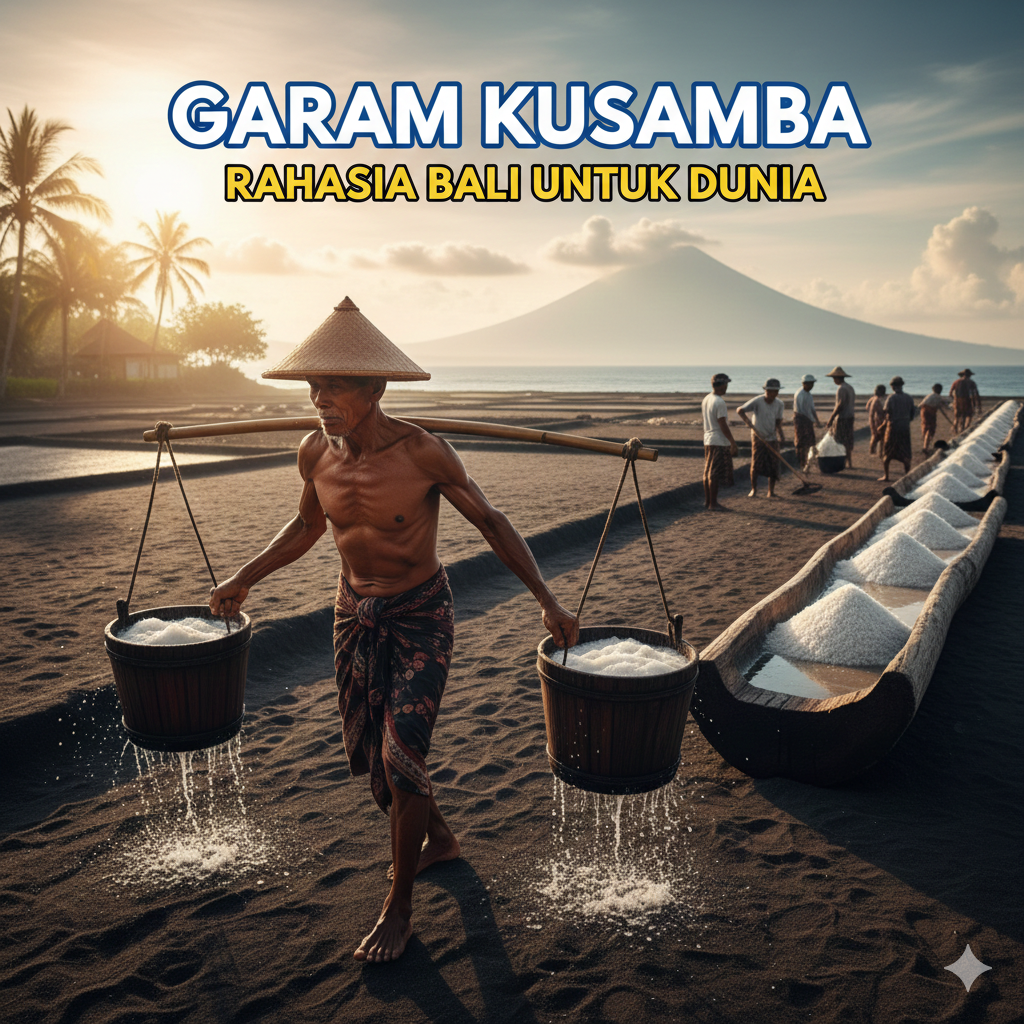

The coastal landscape of East Bali, specifically the village of Kusamba in the Klungkung regency, serves as a profound case study in the intersection of ancestral tradition, geological uniqueness, and modern economic resilience. The production of sea salt in this region is not merely a survivalist labor but a sophisticated technological system that has remained largely unchanged since at least the 16th century.1 This report examines the technical, sociological, environmental, and economic dimensions of the Kusamba salt-making tradition, providing a detailed analysis of how this pre-capitalist mode of production navigates the complexities of a globalized, tourism-driven economy and the existential threats posed by the global climate crisis.
Historical Genesis and the Cultural Identity of Petasikan
The roots of salt production in Bali are deeply embedded in the historical designations of coastal areas known as petasikan, a term derived from the Balinese word tasik, meaning salt.1 Records indicating the existence of these coastal salt-making communities date back centuries, suggesting that the inhabitants of the Balinese coast have mastered the art of extracting minerals from the sea long before the advent of modern industrial chemistry.1 In Kusamba, this tradition has solidified into a communal identity. For the local farmers, salt farming is not just a job; it is a respected heritage passed down through generations, often referred to as a “sentimental taste” that carries the weight of ancestral history.2
The cultural fabric of Kusamba is woven with the rhythms of the sea. Salt making is considered a form of bonding with the earth and seawater, maintaining traditions handed down by ancestors to survive the changing times.2 Despite the physical intensity and relatively low financial reward—often described by the farmers themselves as a “stressful job”—the remaining practitioners continue their work as a matter of legacy.2 However, this legacy is under threat. In recent decades, the number of active salt farmers has dwindled significantly, with reports suggesting that only about 17 to 50 families remain active in the region.2 This decline is driven by the allure of more lucrative employment in the tourism sector and the grueling nature of the work, which fails to attract younger generations.5
Geological and Mineralogical Foundations of the Black Sand
The primary differentiator of Kusamba salt lies in its unique geological setting. Unlike the vast white salt flats found in Madura or Java, Kusamba’s salt is born from volcanic black sand.1 This sand is not merely a surface for evaporation but a critical component in the mineral enrichment process. The black sand is exceptionally mineral-rich, absorbing solar heat more efficiently than lighter sands, which accelerates the initial evaporation phase.4
The interaction between the seawater and the volcanic sand results in a salt profile that is packed with essential nutrients and trace elements.6 These minerals are known to nourish, heal, and revitalize the skin, making Kusamba salt a prized ingredient in both culinary and therapeutic applications.6 The resulting product, often harvested as fleur de sel (flower of salt), is characterized by sweet notes and a savory depth that distinguishes it from industrially refined table salts.4
Comparative Analysis of Salt Production Profiles
The following table highlights the distinctions between the artisanal Kusamba method and conventional industrial production, illustrating the qualitative advantages of the traditional approach.
| Feature | Kusamba Traditional Salt | Industrial Refined Salt |
| Primary Substrate | Volcanic black sand and coconut wood 1 | Concrete or plastic-lined pans |
| Evaporation Source | Solar heat and coastal wind 6 | Industrial boilers or large-scale solar evaporation |
| Mineral Profile | High trace minerals, unrefined 6 | Primarily , stripped of trace elements |
| Chemical Additives | None (100% natural) 4 | Anti-caking agents and artificial iodine |
| Flavor Notes | Savory, light, sweet, lingering 4 | Harshly salty, metallic |
| Environmental Impact | Carbon-neutral, sustainable 9 | High carbon footprint (industrial processing) |
The Technical Artistry of the Palung System
The technology system utilized in Kusamba is known as palung salt technology.1 This method is unique to the coastal communities of Bali, particularly in Amed, Tejakula, and Kusamba, and differs significantly from the boiling methods or large field evaporation used elsewhere in Indonesia.1 The process is a meticulous cycle that requires a deep understanding of weather patterns and mineral crystallization.
Phase I: Solar Imprinting on Volcanic Sand
The cycle begins every morning as farmers carry seawater from the ocean in buckets balanced on bamboo poles.4 This water is poured in a rhythmic motion over raked volcanic sand.6 The midday tropical sun then bakes the sand into salt-laden flakes by late afternoon.4 This stage relies on the high thermal conductivity of the black sand to concentrate the seawater into a solid state within hours.
Phase II: The Leaching and the Belong
Once the sand flakes are harvested, they are taken to salt-making huts for the distillation process. Farmers use a belong, a tub-like wooden container that has often been passed down through generations.2 The sand is placed in the belong, and more seawater is added to leech the salt from the sand, creating a highly concentrated brine.4 This traditional filtration system ensures that only the purest mineral content is carried forward into the final crystallization stage.
Phase III: Crystallization in Coconut Wood Troughs
The final stage involves placing the brine in palung—long troughs made from coconut tree trunks that have been split in half and hollowed out.1 These wooden troughs allow for a controlled evaporation process over several days.5 The porous nature of the wood helps regulate the temperature and moisture levels, allowing the salt to form delicate crystals on the surface. Because of the lingering moisture content, the salt does not dissolve immediately when used in cooking, which is a key factor in its culinary appeal.4
Economic Resilience: The Concept of “Good Capitalism”
A significant academic observation regarding Kusamba salt production is its ability to persist alongside, and even integrate with, the capitalist mode of production. This phenomenon is termed “good capitalism”.1 While traditional modes of production are often marginalized by modern industrial expansion, the palung salt technology has survived because its products possess advantages that align with the needs and image of modern industrial society.1
The survival of this traditional economic institution is attributed to two primary factors. First, the technology system incorporates Balinese socio-cultural values with a strong religious foundation, making it more than just a business.1 Second, the “niche” status of the salt—its reputation for purity and health benefits—has allowed it to penetrate global markets that value authenticity over price.1 However, this survival is precarious. The marginalization of the craft occurs as tourism industrialization narrows the available salt-making areas and draws the workforce away.1
| Economic Variable | Traditional Context | Modern Capitalist Integration |
| Market Target | Local consumption and ritual use 1 | Global gourmet and wellness markets 1 |
| Value Proposition | Ancestral heritage 2 | Sustainable, organic, premium brand 9 |
| Production Motivation | Livelihood and identity 2 | Entrepreneurial expansion and tourism synergy 1 |
| Sustainability | Low-yield, resource-dependent 4 | Integrated with “Slow Food” and “Eco-tourism” 5 |
The Existential Threat of the Climate Crisis
Despite its economic resilience, the Kusamba salt-making tradition faces an unprecedented challenge in the form of the climate crisis. The condition of the farmers has become increasingly “fragile and vulnerable” as the physical landscape of the beach is washed away.2 Coastal abrasion, or erosion, has fundamentally altered the geography of the salt-making areas.
Coastal Abrasion and Land Loss
Farmers have reported losing significant portions of their land to the sea every year. Wayan Ana, a local farmer, noted that he has lost several meters of land annually, leading to a drastic drop in production capacity.2 Historically, the beach was wide enough to support rice fields, temples, and community events like soccer and kite competitions.2 Today, much of this land is submerged or replaced by abrasion protection embankments.2
Infrastructure and Financial Burden
The environmental shift has also imposed new financial burdens. The waves now wash pebbles and large stones onto the production land, requiring farmers to spend days sorting gravel before they can begin work.2 Additionally, the traditional method of carrying water with buckets has become dangerous on the rocky, slippery embankments, forcing farmers to switch to fuel-dependent pumps and suction pipes.2 These pipes are frequently broken by heavy waves, with replacement costs reaching up to 600,000 rupiahs per month—a sum that can exceed the value of the salt produced.2
The Collapse of Traditional Knowledge
Perhaps most distressing is the breakdown of traditional ecological knowledge. Farmers once relied on the lunar calendar (Sasih Karo, Purnama, Tilem) to predict wave patterns and salt yields.2 Ketut Sumartini, a veteran farmer, explained that the waves have become completely unpredictable, with abrasion occurring multiple times in a single week regardless of the moon phase.2 This unpredictability renders the sun-dependent evaporation process extremely risky, as unseasonable rains or sudden surges can ruin an entire week’s labor.
Gastronomy and the Global Culinary Market
While the production side is under pressure, the demand side for Kusamba salt has seen a renaissance in the world of fine dining and luxury wellness. The salt is lauded by chefs for its “savory and light” profile.8 Its status as an unrefined, unbleached, and non-iodized product makes it a “secret ingredient” for adding depth without damaging the original flavors of the food.8
Integration in Bali’s High-End Culinary Scene
Leading restaurants in Bali have adopted Kusamba salt as a core element of their sustainability and local sourcing narratives. Seasalt Seminyak uses the salt as both a seasoning and a centerpiece, with a signature dish featuring snapper baked in a salt crust.9 The restaurant emphasizes its partnership with local farmers in East Bali, viewing the salt as a key to sustainable seafood practices.9
Similarly, Kaum Bali at Potato Head Beach Club integrates Kusamba salt into its authentic Indonesian dishes and its “zero-waste” cocktail program.11 The “Jamu Elixir,” a zero-proof creation, uses the salt to balance the earthy and tangy notes of turmeric and honey.11 These partnerships provide a crucial economic lifeline to the farmers, allowing them to sell their product at a premium price that reflects the labor-intensive nature of its creation.
Consumer Perception and the “Ark of Taste”
The recognition of Kusamba salt by the Slow Food Foundation’s “Ark of Taste” in 2014 has further elevated its international profile.5 Global consumers seek out the salt through specialty distributors like IDSPICES, valuing its “ocean-to-table” freshness and its identity as a “botanical” seasoning suitable for both the kitchen and the spa.7 Reviewers frequently mention the “clean taste and crisp texture” and the “sensory adventure” of using a product that embodies Bali’s coastal treasures.10
Government Policy and the Future of National Salt
The Indonesian government has recognized the strategic importance of salt production, especially as the nation aims for self-sufficiency. Presidential Decree No. 126 of 2022 mandates the acceleration of national salt development to end dependence on imports, which averaged 2.72 million tons annually between 2019 and 2023.12
Self-Sufficiency Targets for 2025-2027
The Coordinating Minister for Food has announced plans to cease all salt imports for consumption by 2025 and to meet industrial salt needs by 2027.12 The roadmap involves a two-pronged strategy:
- Intensification: Modernizing existing salt production through technological innovation, such as the geomembrane method and concentrated brine technology.13
- Extensification: Developing new salt production centers in areas like East Nusa Tenggara and West Java.12
Challenges for the Artisanal Sector
For artisanal producers in Kusamba, these national policies present a mixed bag. On one hand, the government’s push for high-quality local salt creates a supportive environment for their premium product.3 On the other hand, national standards focus heavily on NaCl content (targeting 97-98%) and iodine fortification, which can be at odds with the “natural, unrefined” appeal of traditional sea salt.3 Former Governor of Bali, Wayan Koster, and the Regent of Klungkung have both advocated for improved marketing and packaging to help Kusamba salt compete on a global stage while maintaining its historical identity.3
Digital Content Strategy: Documenting the Crystalline Heritage
For the Kusamba tradition to thrive in the modern era, it must be successfully marketed to a digital-first audience. Based on industry standards for YouTube and website content, the narrative of the salt farmers should be presented with a balance of “findability” and “clickability”.14
Optimizing the Narrative for Digital Discovery
An effective article or video about Kusamba salt must utilize strategic keywords such as “Traditional Bali Sea Salt,” “Kusamba Black Sand,” and “Sustainable Artisanal Food”.15 The title should evoke emotion and curiosity, potentially using numbers or data to highlight the rarity of the craft—for instance, “The Last 17 Salt Masters of Bali”.14
| Content Element | Digital Strategy | Rationale |
| Headline | “Kusamba Sea Salt: The 17th Century Tradition Facing the Climate Crisis” 2 | Evokes emotion and history while highlighting a current conflict. |
| Thumbnail/Visuals | High-contrast images of black sand and sparkling white crystals 5 | Pairs with the title to create a “click-worthy” preview. |
| Description | Detailed explanation of the palung method and mineral benefits 6 | Uses first few lines to capture search engine algorithms and human interest. |
| Engagement | Inviting readers to share their experiences with artisanal food 15 | Encourages comments and likes to boost social media visibility. |
Synthesis and Strategic Outlook
The analysis of the Kusamba sea salt industry reveals a complex interplay between a dying tradition and a rising global appreciation for artisanal craftsmanship. The farmers of Kusamba are the guardians of a 500-year-old technological system that produces one of the finest salts in the world, yet they are increasingly vulnerable to the very ocean they depend on.
The concept of “good capitalism” suggests that there is a path forward through integration with the luxury tourism and global gourmet markets. However, this path requires a proactive response to the climate crisis. The current ad-hoc solutions to coastal abrasion are insufficient; a more sustainable approach to coastal management is needed to preserve the physical space required for salt making. Furthermore, the transition of the craft to a new generation will depend on whether it can be repositioned as a prestigious and profitable profession, supported by government initiatives and fair-trade partnerships with the high-end culinary industry.
In conclusion, Kusamba sea salt is more than a seasoning; it is a crystalline repository of Balinese history, geology, and resilience. Its preservation is not only an economic necessity for the local community but a cultural imperative for a world that increasingly values the authentic and the sustainable. As Indonesia moves toward its 2025 goal of salt self-sufficiency, the artisanal salt masters of Kusamba must be central to that vision, ensuring that the “white gold” of the volcanic coast continues to sparkle for generations to come.
Works cited
- Ancient communal mode of production of sea salt commodity in Bali …, accessed February 24, 2026, https://www.tandfonline.com/doi/full/10.1080/23311886.2025.2523074
- Kusamba’s Vanishing Salt – www.iklimku.org, accessed February 24, 2026, https://iklimku.org/kusambas-vanishing-salt/
- Bali Government’s Strategic Plan to Introduce Kusamba Salt Worldwide – Semantic Scholar, accessed February 24, 2026, https://pdfs.semanticscholar.org/4fe3/41fd44beece7ee57b4be1f0fb1af95cb5930.pdf
- Kusamba Sea Salt Farmers – Seasalt, accessed February 24, 2026, https://seasaltseminyak.com/journey/kusamba-sea-salt-farmers.html
- Kusamba Sea Salt – Google Arts & Culture, accessed February 24, 2026, https://artsandculture.google.com/story/kusamba-sea-salt-slow-food/_QVBwVdKyx8A8A?hl=en
- About Us – Kusamba, accessed February 24, 2026, https://kusambasalts.com/pages/about-us
- Balinese Kusamba Sea Salt 100g Natural Sun-Dried Culinary Botanical | eBay, accessed February 24, 2026, https://www.ebay.com/itm/389196001898
- Bali Kusamba Premium 250g Sea Salt Natural Pure Organic Health Beauty Original | eBay, accessed February 24, 2026, https://www.ebay.com/itm/386872186742
- Seasalt Seminyak: A Sustainable Seafood Restaurant By The Beach | Almost Landing – Bali, accessed February 24, 2026, https://almostlanding-bali.com/seasalt-seminyak-restaurant/
- – Balinese Kusamba Sea Salt, Hand-Harvested Sea Salt from Bali, All-Natural Smal | eBay, accessed February 24, 2026, https://www.ebay.com/itm/187749719435
- Beach Club in Seminyak – Potato Head, accessed February 24, 2026, https://seminyak.potatohead.co/feast/beach-club
- TRANSFORMING INDONESIA’S SALT INDUSTRY: FROM IMPORT DEPENDENCE TO SELF-SUFFICIENCY 11 – DPR RI, accessed February 24, 2026, https://berkas.dpr.go.id/pusaka/files/info_singkat/Info%20Singkat-XVI-23-I-P3DI-Desember-2024-220-EN.pdf
- Indonesia Aims to Achieve Salt Self-Sufficiency by 2027, accessed February 24, 2026, https://britcham.or.id/indonesia-aims-to-achieve-salt-self-sufficiency-by-2027/
- YouTube Title Generator Tool, accessed February 24, 2026, https://tuberanker.com/youtube-title-generator
- AI Youtube Title Generator Tool | Veefly, accessed February 24, 2026, https://veefly.com/youtube-title-generator/
- AI YouTube Title Generator [Free] – Hootsuite, accessed February 24, 2026, https://www.hootsuite.com/social-media-tools/ai-youtube-title-generator-free
- Tips for video descriptions – YouTube Help, accessed February 24, 2026, https://support.google.com/youtube/answer/12948449?hl=en